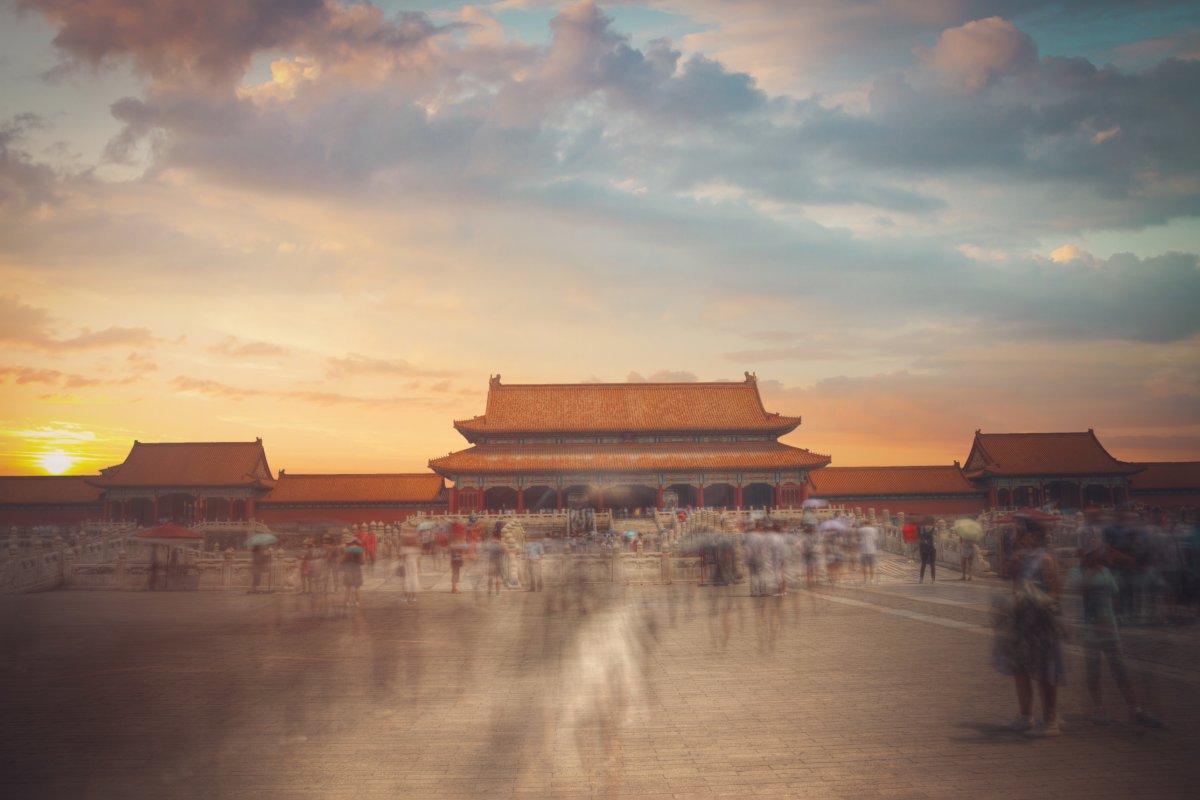
When you stand in the vast courtyard of the Forbidden City, you are not merely standing in the center of Beijing; according to ancient Chinese cosmology, you are standing at the center of the terrestrial world, directly aligned with the heart of the heavens. For centuries, the emperors of China were regarded as the 'Sons of Heaven,' intermediaries between the celestial realm and the earthly domain. This profound responsibility meant that their residence could not be a simple collection of buildings. Instead, it had to be a perfect mirror of the cosmos, a physical manifestation of divine order designed to maintain harmony between the sky and the land. To truly appreciate the magnitude of this site, one must look beyond the red walls and golden roofs to understand the astronomical precision embedded in its foundation.
The design of the Forbidden City is a complex tapestry woven from astronomy, Feng Shui, and imperial philosophy. It was constructed not just to impress visitors with its scale, but to legitimize the emperor's rule through celestial alignment. Every gate, hall, and walkway follows a strict code that corresponds to star charts and seasonal changes. As we explore the palace in January 2026, the winter light reveals shadows and angles that were calculated with mathematical precision over 600 years ago. Before you book your Tickets to witness this marvel, let us journey through the stars and stone to uncover the secrets of the Purple Forbidden City.
The North Star and the Purple Palace
In traditional Chinese astronomy, the North Star (Polaris) is regarded as the center of the heavens. It is the only stationary point in the night sky around which all other stars revolve, symbolizing the Emperor who sits at the center of the court while his subjects rotate around him. The ancient name for the Forbidden City is 'Zi Jin Cheng,' which translates to the 'Purple Forbidden City.' The color purple here refers to the 'Purple Tebb' (Zi Wei Yuan), a constellation associated with the North Star, believed to be the celestial abode of the Heavenly Emperor. Consequently, the earthly emperor's residence was built to mimic this celestial palace, placing the ruler at the pivot point of the mortal world.
This connection dictates the entire layout of the complex. The palace faces south, turning its back to the cold north, just as the North Star anchors the northern sky. This orientation is not merely for protection against northern winds but is deeply rooted in the belief that the south represents the direction of holiness and growth. To explore how these concepts were physically constructed, you can delve deeper into the palace's Architecture, where cosmic theory transforms into brick and mortar.
The Central Axis: The Meridian Line
The most significant architectural feature of the Forbidden City—and indeed, of historic Beijing—is the Central Axis. This invisible line runs north-south, bisecting the imperial complex and aligning perfectly with the celestial meridian. It is often referred to as the 'Dragon's Vein' of the city. All the most important structures, including the Hall of Supreme Harmony, the Hall of Central Harmony, and the Hall of Preserving Harmony, sit squarely on this axis. This alignment ensured that when the emperor sat on his throne, he was perfectly centered, facing south to receive the energy of the sun at its zenith.
The precision of this axis is astounding. It extends far beyond the palace walls, reaching the Drum and Bell Towers to the north and the Yongdingmen Gate to the south. Visitors walking this line today are tracing a path meant for gods and emperors. Because the complex is so massive, covering 180 acres, following this central axis is the most popular route for first-time visitors. To ensure you don't miss the key structures along this celestial line, we recommend reviewing our curated Itineraries before you arrive.
The Hall of Supreme Harmony and Solar Alignments
The interplay between the sun and the architecture reaches its peak at the Hall of Supreme Harmony. As the largest hall in the palace, it was the venue for grand ceremonies. The architects possessed an advanced understanding of solar movement. The eaves of the hall are designed at a specific angle to allow sunlight to illuminate the interior floor during the Winter Solstice, while providing shade during the Summer Solstice. This wasn't just practical for temperature control; it was symbolic of the emperor's control over time and the seasons.
Inside the hall, the famous 'Dragon Throne' is positioned so that on specific days, sunlight frames the emperor, enhancing his divine aura. Capturing the light in this way requires precise timing. The placement of the throne was meticulously calculated, a testament to the advanced astronomical knowledge of the imperial court. For instance, during the Qing Dynasty, Jesuit missionaries, skilled in astronomy and mathematics, were employed to further refine these calculations, ensuring the emperor's connection to the cosmos remained perfectly aligned. If you are a photography enthusiast hoping to catch the way light plays off these ancient structures, our Photography Guide offers advice on the best angles and times of day, particularly during the 'golden hour.'
Celestial Symbolism in Numbers and Beasts
The influence of astronomy extends to the numerology used throughout the palace. The number nine is considered the largest single-digit number and is associated with the Emperor and the heavens (yang energy). Consequently, the design incorporates the number nine repeatedly. It is said that the Forbidden City originally contained 9,999.5 rooms—just half a room short of the 10,000 rooms believed to exist in the celestial palace of the Jade Emperor, showing a humble deference to heaven. While the actual count is lower, the symbolism remains potent.
Furthermore, the roof ridges of the most important halls are lined with mythical beasts. The Hall of Supreme Harmony features exactly ten beasts (including the immortal riding a phoenix), a unique distinction in Chinese architecture. These figures are not random decorations; they represent a hierarchy of protection, guarding the palace against disasters like fire and thunder—threats that come from the sky. These beasts, known as 'Ruyi,' were not always present. Their addition and arrangement evolved over dynasties, reflecting changing beliefs and imperial power. To understand the timeline of when these symbolic elements were added or restored, a look at the site's History is essential.
- The Dragon: Represents the Emperor and imperial power.
- The Phoenix: Represents the Empress.
- The Lion: Symbolizes power and majesty.
- The Heavenly Horse: Symbolizes traveling through the sky.
- The Bull: Believed to prevent floods and disasters.
Astronomical Instruments and Timekeeping
The Forbidden City was not just a symbolic representation of the cosmos; it was also a functional center for timekeeping, which was inextricably linked to astronomy. The ability to predict eclipses and create accurate calendars was a primary duty of the imperial court, demonstrating the emperor's connection to the heavens. The Directorate of Astronomy, a governmental body, was responsible for these tasks. Their calculations influenced not only imperial rituals but also agricultural practices across the empire. Within the complex, you will find ancient sundials (Rigui) positioned in front of major halls. These were not merely decorative; they were practical tools used to mark the time based on the shadow cast by the sun, aligning the emperor's schedule with solar movements.
The following table highlights the relationship between specific architectural features and their astronomical functions or symbolism:
| Architectural Feature | Astronomical/Cosmic Connection | Symbolic Meaning |
| Meridian Gate (Wumen) | Aligned with the Solar Meridian | The entry point for the Son of Heaven; marks the separation of the earthly and imperial worlds. |
| Imperial Garden (Yuhuayuan) | Four Seasons Pavilions | Represents the cycle of time and the harmony of nature's rhythms. |
| Inner Court | Represents the Terrestrial North | The private quarters, mirroring the hidden, pivotal nature of the North Star. |
| Roof Ridge Beasts | Guardians against Celestial Elements | Protection from lightning and fire; maintaining order against chaos. |
Planning Your Celestial Visit
Understanding the astronomical depth of the Forbidden City transforms a visit from a simple sightseeing tour into a journey through ancient philosophy. To see these alignments clearly, the timing of your visit matters. The lighting during the solstices and equinoxes is particularly dramatic, but the stark shadows of winter can also be breathtaking. For detailed advice on when to schedule your trip to avoid crowds and get the best weather, consult our guide on the Best Time to Visit.
Getting to the palace is straightforward, as it sits at the very heart of the city, but navigating Beijing's transit system can be daunting for newcomers. Whether you prefer the subway or a private car, our How to Get There page details the most efficient routes. Once you have finished exploring the imperial cosmos, remember that the surrounding area is rich with history. The Jingshan Park, located directly north, offers a panoramic view of the Forbidden City's axis, allowing you to see the celestial alignment from above. You can find more details about this and other sites in our Nearby Attractions section.
Before you head out, always check the Opening Hours, as the museum is closed on Mondays and hours shift with the seasons. A visit to the Forbidden City is an encounter with a civilization that looked to the stars to build their home on earth. It is a testament to the human desire to find order in the universe and to construct a legacy that aligns with the eternal dance of the cosmos.